
The History of the Making of the United Nations Convention on the Rights of Persons with Disabilities (CRPD)
Series One by the Nigeria’s National and International Disability Civil Rights Movement and Policy Change Advocate -Ad hoc consortium
The adoption of the United Nations Convention on the Rights of Persons with Disabilities (CRPD), on December 13, 2006, by the UN Member States was a global historic achievement and legacy milestone in the global fight for disability rights, which deserved and earned the rights to be nominated to win a Nobel Peace Prize. This is the time to do the needful by completing the nomination on or before December 13, 2026, the Twentieth Anniversary.
The journey began with General Assembly Resolution 56/168, passed on December 19, 2001, which established the Eighth Sessions Ad Hoc Committee to draft a comprehensive and integral international convention to promote and protect the rights and dignity of persons with disabilities. This effort was based on a holistic approach considering social development, human rights, and non-discrimination, incorporating recommendations from the Commission on Human Rights and the Commission for Social Development. His Excellency Ambassador Don McKay was the Chair of that very Successful, UN Eighth Sessions Ad Hoc Committee on a Comprehensive and Integral International Convention on the Protection and Promotion of the Rights and Dignity of Persons with Disabilities [A/RES/60/232].
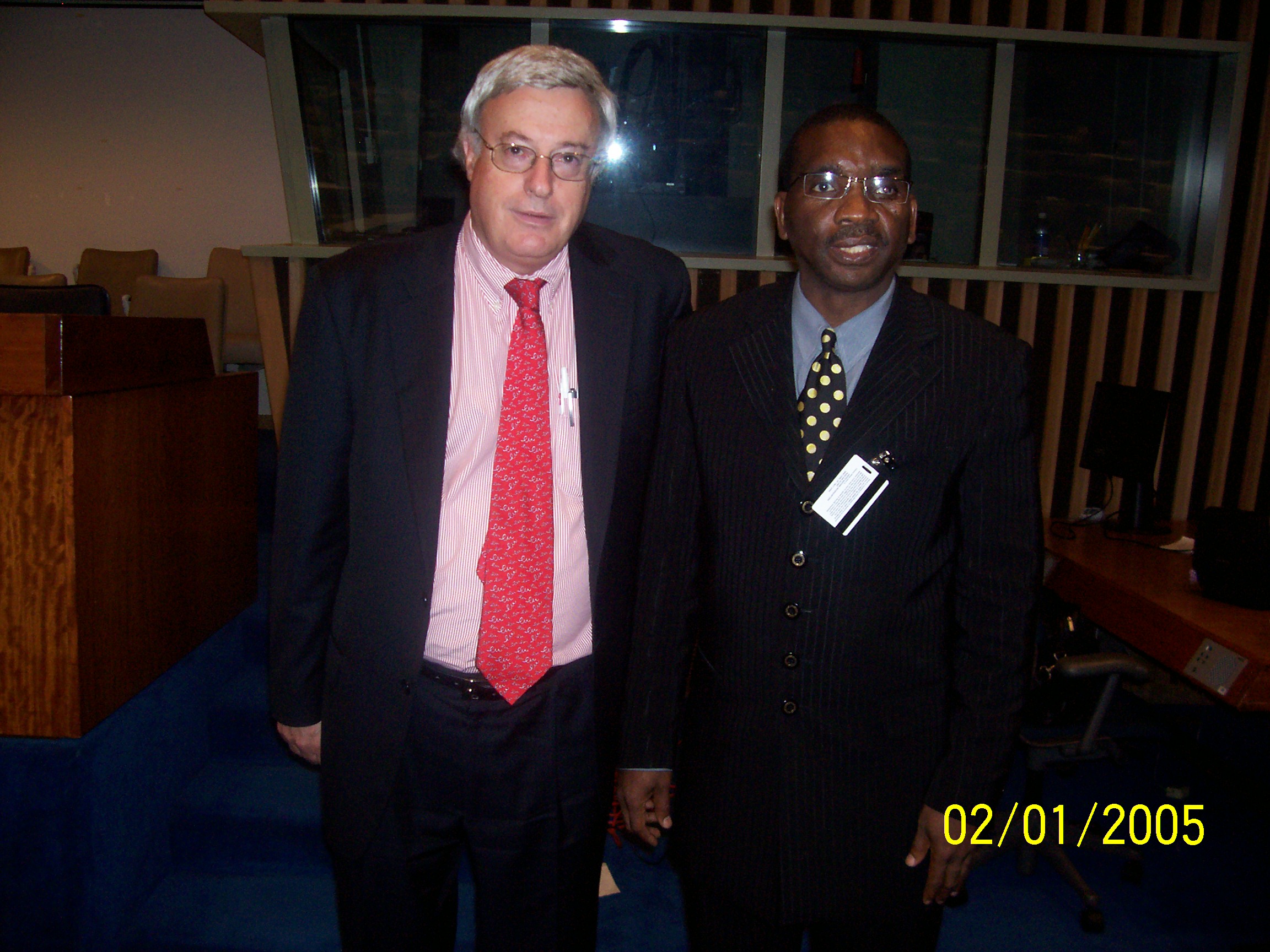
L-R: His Excellency Ambassador Don McKay of New Zealand, Chair UN 8th Sessions Ad Hoc Committee, and Chief Eric Ndubueze Ufom, on January 2-3, 2005, during New York very cold Winter Days with huge Snow at the UN Headquarters, New York and Rehabilitation International (RI-Global) Event, as Nigeria’s Official Delegates to the United Nations and a members of the Rehabilitation International (RI-Global), Disabled Peoples International (DPI), United States Civil Society Delegate to the UN, International Disability Alliance (IDA) and its defunct International Disability Caucus members of the UN Eighth Sessions Ad Hoc Committee on a Comprehensive and Integral International Convention on the Protection and Promotion of the Rights and Dignity of Persons with Disabilities [A/RES/60/232], who represented more than 1.3 billion persons with disabilities worldwide, including over 35.5 million Nigerians and 70 million Americans
The Work of the Ad Hoc Committee
- The First Session of the Ad Hoc Committee took place from July 29 to August 9, 2002, gathering input from states, UN bodies, and disability-focused organisations.
- The Second Session (June 16-27, 2003) led to the creation of a Working Group tasked with drafting a convention text.
- The Working Group, including representatives of member states, NGOS, and human rights institutions, met from January 5-16, 2004, to develop a draft.
- By General Assembly Resolution 58/246, negotiations began at the Third Session (May 24 – June 4, 2004), based on the Working Group’s draft.
- The Committee completed two readings of the draft convention during its Third, Fourth, Fifth, and Sixth Sessions (2004-2005).
- During the Seventh Session (January 16 – February 3, 2006), the Ad Hoc Committee reviewed a consolidated draft.
- At the Eighth Session (August 14-25, 2006), the final draft text of the Convention, including an Optional Protocol, was adopted without a vote. The Committee established a Drafting Group to ensure uniform terminology and harmonisation across UN languages.
- On December 5, 2006, the Chairman of the Drafting Group presented the final report, and the Committee forwarded the draft Convention and Optional Protocol to the UN General Assembly.
- On December 13, 2006, the General Assembly adopted the CRPD and Optional Protocol by consensus.
- The Convention opened for signature on March 30, 2007, at the UN Headquarters in New York, with 82 signatories—the highest number in UN history for a convention on its opening day.
- The CRPD entered into force on May 3, 2008.
The significance of the United Nations Convention on the Rights of Persons with Disabilities (UN CRPD) as a 21st-century human rights treaty lies in its unprecedented unification of global disability rights leaders and stakeholders. Spearheaded by the International Disability Alliance (IDA), an International Disability Caucus (IDC) was formed to lead the global advocacy and negotiations with UN Member States. These efforts culminated in the historic adoption of the UN CRPD on December 13, 2006.
As we commemorate the 18th anniversary of Nigeria’s signing of the UN CRPD, we also commend the IDA for its unwavering dedication to the full protection and promotion of the human rights of more than 1.3 billion persons with disabilities worldwide, including over 35.5 million Nigerians. Through its strategic use of the UN CRPD and other human rights instruments, the IDA has helped to secure historic global progress and visibility for disability rights. These achievements, well-documented and recognized by the United Nations Department of Economic and Social Affairs (UN DESA), merit consideration for a Nobel Peace Prize in honour of the 20th Anniversary of the UN CRPD.
Regrettably, despite being the most populous Black Nation with persons with disabilities, Nigeria was underrepresented during the United Nations’ Eighth Session of the Ad Hoc Committee on a Comprehensive and Integral International Convention on the Protection and Promotion of the Rights and Dignity of Persons with Disabilities [A/RES/60/232]. Out of an estimated more than 27 million Nigerians with disabilities, only two individuals represented the country, both as part of the official delegation and civil society. These pioneering figures were Chief Eric Ndubueze Ufom, President, and Lady Dorothy (Doi) Mbanefo, PRO of Equal Rights for Persons with Disabilities International, Inc. (ERPWDI), also known as Equal Rights for Persons with Disabilities Initiative.
Media Contact:
The Secretariat
Pioneers of Nigeria’s National and International Disability Civil Rights Movement and Policy Change Advocates (Ad Hoc Consortium)
📞 +234 706 847 3214
✉️ vov4pwd@gmail.com
📍 Abuja, Nigeria